



Day vs Night Commercial Cleaning: Which Is Better?
Updated: Sep 15
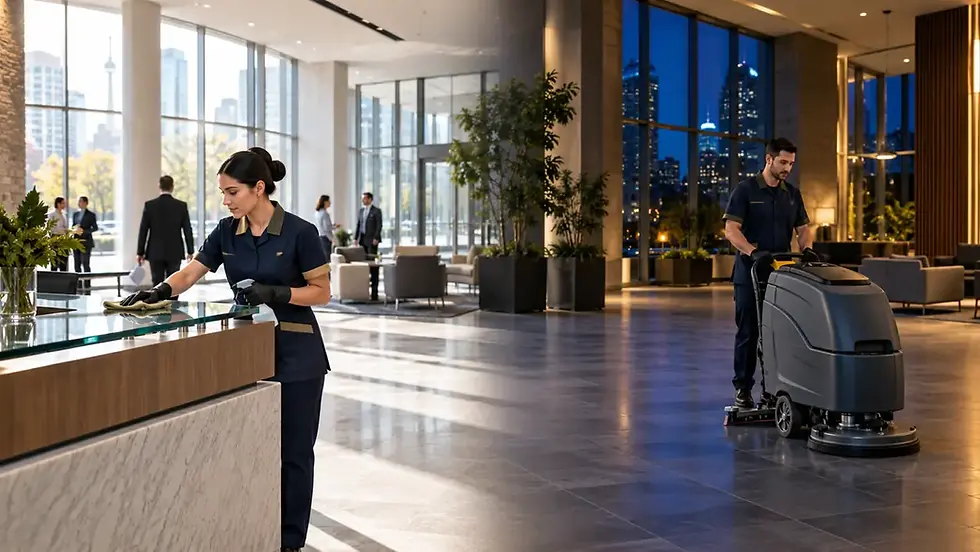
Choosing between daytime and nighttime commercial cleaning is not simply a matter of preference. The appropriate service period depends on when a facility operates, which areas cleaners need to access, how cleaning activities affect employees and visitors, and what security procedures apply when the building is occupied or closed.
For Ontario businesses comparing day vs night commercial cleaning, the better arrangement is the one that allows the required work to be completed consistently without interfering with normal facility operations.
What Is the Difference Between Day and Night Commercial Cleaning?
Daytime commercial cleaning takes place while a business or facility is operating. Employees, customers, contractors or members of the public may remain in the building while cleaners complete some or all of the scheduled work. Cleaning may continue throughout the day or take place during selected periods when particular areas are less active.
Nighttime commercial cleaning generally begins after regular business hours. Depending on the property, it may occur in the evening, overnight or during another period when occupancy is substantially reduced. Cleaners may work while the building is empty or while only limited operations continue.
Both arrangements can support an effective commercial cleaning program. The important distinction is how each schedule affects access, disruption, safety, supervision and communication. The decision should be based on the facility rather than an assumption that every property should be cleaned at the same time.
JaniTech provides commercial cleaning services across Ontario with programs developed around the way each workplace, building or operational facility actually functions.
When Daytime Commercial Cleaning Works Well
Daytime cleaning can be effective in properties that remain open for extended hours or require certain areas to receive attention throughout the operating day. A facility does not always have a practical period when the entire building is vacant. Waiting until night may not resolve access problems in buildings that operate across multiple shifts.
Cleaning during the day can provide timely attention to entrances, washrooms, breakrooms and other frequently used areas. These spaces may need service more than once during a long operating period. A daytime cleaning presence allows responsibilities to follow actual building use instead of being limited to one visit after closing.
Communication can also be more direct when customer representatives and cleaners are present simultaneously. Facility personnel can identify changing conditions, explain temporary access restrictions and raise concerns without waiting until the next service period. Cleaners can report maintenance problems, supply shortages or unexpected conditions as they encounter them.
Daytime cleaning must still be coordinated carefully. Equipment, carts, wet floors and temporary access restrictions can interfere with employees or visitors when work occurs during busy periods. The cleaning scope may need to distinguish between tasks suitable for occupied spaces and responsibilities that should wait until pedestrian traffic decreases.
When Nighttime Commercial Cleaning Is More Practical
Nighttime cleaning is often appropriate for conventional offices, administrative buildings and customer-facing properties with predictable closing times. Lower occupancy can give cleaners more direct access to workstations, meeting rooms, corridors, washrooms and shared facilities.
Reduced pedestrian traffic also makes some floor-cleaning responsibilities easier to complete.
Cleaners can move through larger areas without repeatedly stopping for occupants, and cleaned surfaces may have more time to dry before the building becomes active again.
Night cleaning can reduce visible disruption during the business day. Vacuums, cleaning equipment and supply carts are less likely to interfere with meetings, telephone calls, customer service or routine employee movement when most occupants have left.
The arrangement still requires planning. Cleaners may need keys, access cards, alarm instructions and authorization to enter restricted areas. The customer and cleaning company must agree on opening and securing procedures, emergency contacts and the handling of unexpected conditions. A quiet building does not automatically create a simple cleaning environment.
Facility Operations Should Determine the Cleaning Period
A standard office may have a clear separation between occupied and unoccupied hours. A warehouse, manufacturing facility, transportation property or extended-hour workplace may not. Production, shipping, receiving and employee movement can continue across multiple shifts, leaving no single period when every area is available.
Cleaning in these environments may need to follow operational zones rather than a traditional day-or-night division. Employee facilities might be cleaned between shifts, administrative offices after personnel leave and selected operational areas during scheduled pauses. The most appropriate service window for one part of the building may be unsuitable for another.
Facility managers should consider which areas are busiest, when those areas become accessible and whether cleaning could introduce temporary hazards into active workspaces. They should also identify tasks that require equipment, additional preparation or uninterrupted access.
Cleaning frequency and cleaning time are connected, but they are not the same decision. Frequency establishes how often an area requires attention. Scheduling determines when that work can be completed effectively. JaniTech’s commercial cleaning process explains how facility conditions, responsibilities, frequency and operating requirements are incorporated into a structured cleaning program.
Access, Security and Supervision Affect the Decision
Daytime cleaning generally occurs while customer personnel are available, but cleaners must work around occupied areas. Nighttime cleaning provides greater physical access while creating additional security responsibilities.
An after-hours arrangement should define how cleaners enter and leave the property, which doors may be used, how alarms are handled and which areas remain restricted. The cleaning company should know who to contact if an access card fails, an alarm activates or an unexpected person remains in the building.
Sensitive documents, personal belongings, controlled spaces and valuable equipment can also influence the schedule. Some organizations prefer cleaning while a supervisor or facility representative is present. Others prefer an empty building with clearly controlled access.
Supervision does not necessarily require a customer representative to watch the cleaning work. It means responsibilities, access rules, reporting procedures and escalation contacts have been established. A well-defined nighttime program can be highly controlled, while a poorly planned daytime program can still create uncertainty.
Cleaning Around Employees and Building Occupants
Occupied cleaning requires consideration for the people using the facility. Cleaners may need to delay work in meeting rooms, customer areas or washrooms until those spaces become available. Noise-producing tasks may need to be scheduled outside peak periods, while quieter responsibilities can proceed during normal hours.
Safety also matters. Wet-floor controls, equipment placement and temporary access restrictions must be managed wherever people continue moving through the building. The objective is to complete the required cleaning without creating unnecessary interference or risk.
Nighttime work reduces many occupancy conflicts but does not eliminate them in every facility. Security personnel, late-working employees, contractors or shift workers may remain present. Cleaning teams still need to understand which areas are active and how their responsibilities intersect with those occupants.
A realistic schedule accounts for the facility’s actual behaviour rather than relying exclusively on its posted hours. A building may officially close at a particular time while employees continue working, deliveries arrive or maintenance activities take place.
Some Facilities Benefit From a Combined Cleaning Schedule
The choice does not always need to be exclusively day or night. A combined cleaning schedule can assign different responsibilities to separate service periods. High-use washrooms, entrances and employee common areas may receive daytime attention, while detailed office cleaning, vacuuming and broader floor work occur after occupancy falls. A warehouse may require selected employee spaces to be serviced during shift changes and administrative areas to be cleaned in the evening.
A combined arrangement can improve responsiveness without placing every cleaning responsibility inside an occupied service window. It can also prevent conditions from accumulating throughout a long operating day. The division of work must remain clear. The cleaning scope should identify what occurs during each service period, how often it happens and who is responsible for responding to conditions outside the scheduled work. Without that distinction, a combined schedule can create uncertainty about whether a task was missed or assigned to another visit.
Businesses evaluating office service times can review JaniTech’s office cleaning frequency and scheduling guide for a closer examination of how occupancy, traffic and workplace patterns affect office cleaning schedules.
Day vs Night Commercial Cleaning FAQs
Is Daytime or Nighttime Commercial Cleaning Better?
Neither option is automatically better for every facility. Daytime cleaning can provide ongoing attention and direct communication, while nighttime cleaning can improve access and reduce disruption. The better choice depends on occupancy, operating hours, security procedures and the areas included in the cleaning scope.
Is Daytime Cleaning Disruptive to Employees and Customers?
Daytime cleaning can be disruptive if noisy equipment, wet floors or cleaning carts are introduced during busy periods without proper coordination. It can work effectively when responsibilities are matched to lower-traffic periods and cleaners follow procedures appropriate for occupied spaces.
Does Nighttime Cleaning Require Special Building Access?
Nighttime cleaning commonly requires keys, access cards, alarm instructions, emergency contacts and clearly defined opening or closing procedures. These requirements should be confirmed before service begins and updated whenever the building’s access or security procedures change.
Can a Commercial Facility Use Both Daytime and Nighttime Cleaning?
Yes. Some facilities assign high-use areas and immediate needs to daytime cleaning while scheduling detailed or less occupant-compatible work for the evening. The responsibilities allocated to each period should be documented clearly in the cleaning scope
Choose a Commercial Cleaning Schedule That Fits the Facility
The right cleaning period is the one that provides reliable access to the required areas while protecting normal business operations. Daytime service may suit facilities that need an active cleaning presence or remain open for extended hours. Nighttime service may be more practical where occupancy falls predictably and cleaners can work with fewer interruptions.
Some properties need a combination of both. What matters is that the schedule reflects building use, operational restrictions, security requirements and the agreed scope of work.
Ontario businesses can request a commercial cleaning estimate to discuss their facility, required service areas and appropriate cleaning schedule with JaniTech.