



What Causes Heavy Commercial Floor Finish Buildup?
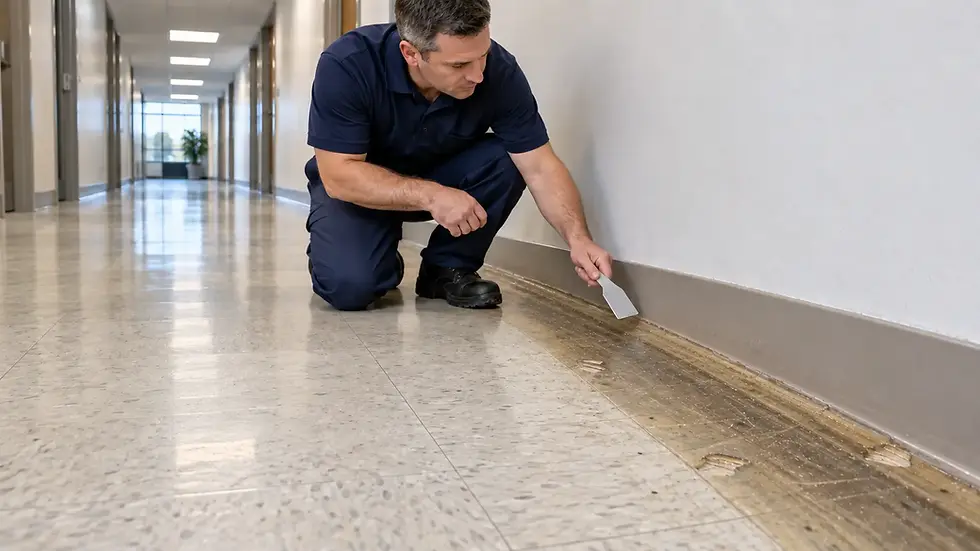
Heavy commercial floor finish buildup develops when new coats are repeatedly applied without removing enough worn, damaged or contaminated finish underneath. The floor may initially appear glossy, but excessive layers can create dark edges, uneven colour, embedded soil and a surface that becomes increasingly difficult to maintain.
Understanding what causes heavy commercial floor finish buildup helps facility managers determine whether the floor can still be improved through routine maintenance or requires complete stripping and refinishing.
What Heavy Floor Finish Buildup Looks Like
Floor finish is designed to form a protective film over compatible resilient flooring. Multiple coats are normally applied during refinishing to create an even, maintainable surface. Buildup becomes a problem when the total film is excessive, poorly bonded or contaminated between layers.
The condition may appear as a thick or plastic-looking surface, especially along edges and in areas that receive little traffic. Finish can darken near baseboards, beneath furniture and around fixed objects because these locations are repeatedly coated but receive less wear than open traffic lanes.
The floor may also show yellowing, uneven depth, visible application lines or a pronounced difference between protected areas and heavily used routes. Scratches can appear trapped below newer coats, making them impossible to remove through ordinary cleaning. In severe cases, the finish may chip or separate because the upper layers depend on an unstable film beneath them.
Heavy buildup should be evaluated across the complete floor rather than judged from one glossy section. Managers considering restorative work can review JaniTech’s Ontario commercial floor stripping and refinishing service to understand how accumulated finish is removed before a new system is applied.
Recoating Without Adequate Preparation
Repeated recoating is one of the most common causes of excessive finish accumulation. A maintenance team may add coats whenever the floor loses gloss, even though the existing surface contains embedded soil, scratches or worn layers that should be addressed first.
Recoating can be appropriate when the existing finish remains sound and the floor is properly cleaned and prepared. The problem arises when the decision is based only on appearance. Applying more product can temporarily increase gloss while sealing underlying defects into the floor.
Preparation must remove soil, residues and weak surface material so the new finish can bond to a stable layer. If the floor is only damp mopped before recoating, contaminants may remain between coats. Over time, the film becomes thicker without becoming stronger or cleaner.
A documented maintenance history helps prevent automatic recoating. The decision should consider how many coats have been added, which areas were treated and whether the existing film still responds to the intended maintenance process.
Applying Too Much Finish During Each Coat
Floor finish should be applied in controlled, even coats. Applying excessive product in one pass does not necessarily create better protection. A heavy coat may dry unevenly, trap moisture or leave visible ridges and application patterns.
Application thickness can vary when the applicator releases too much product, the technician works inconsistent sections or additional finish is poured directly onto the floor without adequate control. Edges and corners may receive overlapping passes, creating thicker film than the centre of the area.
Heavy application also extends drying time. If the next coat is applied before the previous layer is ready, moisture and solvents may remain within the finish system. The floor can then develop haziness, softness or poor adhesion in addition to excessive thickness.
More coats and heavier coats are not interchangeable. A planned finish system uses the appropriate number of controlled applications with sufficient drying between them. The objective is a durable, even film rather than the greatest possible amount of product.
Uneven Wear Creates Buildup Along Edges
Commercial floors do not wear evenly. Entrances, main corridors and routes between work areas lose finish faster than edges, corners and spaces beneath furniture. If the entire floor is recoated on the same schedule, low-traffic areas continue accumulating film while busy routes may still appear thin.
This difference is often visible as dark borders near walls or around permanent fixtures. Soil can become embedded in the thick edge finish, creating a grey or brown outline that routine mopping does not remove. Repeated application can make the border progressively wider and more noticeable.
Furniture changes can expose additional evidence. An area protected beneath a cabinet or display may contain significantly more finish than the surrounding traffic lane. When the item is moved, the floor can show a raised outline or a different colour.
Maintenance planning should account for wear patterns rather than treating every square metre identically. Some areas may need interim restoration while others require less frequent recoating. Eventually, however, accumulated differences can only be corrected by removing the finish and rebuilding the surface consistently.
Contaminated Layers Can Darken the Floor
Soil does not always remain on top of the finish. If the floor is not cleaned and neutralized effectively before a new coat is applied, fine dirt, cleaning residue and old maintenance product can become sealed inside the film.
Each contaminated layer may be subtle, but repeated recoating can gradually alter the floor’s colour. Light flooring may appear grey, yellow or brown even after thorough surface cleaning. The discolouration can be strongest along edges where thick finish and limited agitation allow soil to remain.
Residue from an incompatible cleaner can also affect clarity and adhesion. Product remaining after cleaning may interfere with the next coat or create a surface that attracts additional soil. Using more finish to cover the appearance does not remove the cause.
A test cleaning can help distinguish surface soil from contamination trapped within the finish. When cleaning improves the surface only slightly and the dark appearance remains below it, restorative removal may be more appropriate than another maintenance coat.
Why More Burnishing Does Not Remove Buildup
Burnishing can improve gloss and help manage certain marks when the finish system and floor condition are suitable. It does not remove the complete accumulation of old finish. Treating heavy buildup as a gloss problem can therefore make the surface look brighter without correcting its excessive thickness or embedded contamination.
Aggressive or repeated machine work can produce uneven results when the film varies across the floor. High areas may respond differently from thin traffic lanes. Edges that the equipment cannot reach continue to retain thick, dark finish while open sections receive more mechanical action.
Burnishing also cannot repair weak adhesion between older coats. If the finish has begun to chip, flake or separate, increasing gloss on the top layer does not stabilize the material underneath.
Routine maintenance remains valuable when the finish is structurally sound. JaniTech’s commercial floor finish maintenance guidance explains how ongoing care can preserve a properly established finish system between restorative projects.
When Heavy Buildup Requires Complete Stripping
Complete stripping should be considered when the finish is excessively thick, heavily discoloured, contaminated through multiple layers or no longer responding evenly to maintenance. The same may apply when edges have developed pronounced dark borders or older coats are separating beneath newer ones.
Stripping uses a controlled process to break down and remove the existing finish so the underlying flooring can be rinsed, inspected and prepared. The objective is not simply to reduce gloss. The old film must be removed thoroughly enough to provide a stable and visually consistent base for the new finish.
The condition of the flooring beneath the finish also matters. Removal may reveal permanent staining, tile damage, colour differences or earlier repairs that were partially concealed. Refinishing can improve and protect compatible flooring, but it cannot reverse structural damage or restore material that has worn away.
A test area may help establish how readily the buildup releases and what the exposed floor looks like. This information supports realistic planning for labour, equipment, service time and the expected result.
Preventing Excessive Finish From Returning
Prevention begins with a maintenance plan that records when finish is applied and why. Recoating should respond to the condition of the existing film rather than follow an automatic schedule that ignores wear patterns.
The floor should be cleaned with compatible products and prepared appropriately before any new finish is added. Residue, soil and weak surface material must not be sealed beneath another coat. Application methods should produce controlled coverage without excessive overlap along edges.
Facility managers should monitor traffic lanes, borders, spaces beneath movable furniture and areas around permanent fixtures. These locations reveal whether the floor is wearing and accumulating finish unevenly. Moving accessible furniture during inspections can expose changes that are not visible in open areas.
Periodic assessment also helps distinguish a maintenance need from a restorative one. Continuing to recoat a failing finish may postpone the project while increasing the amount of material that ultimately must be removed.
Heavy Commercial Floor Finish Buildup FAQs
How can I tell whether a floor has too much finish?
Heavy buildup may appear as thick, dark or yellowed film, particularly along edges and beneath furniture. The floor may contain trapped scratches, visible coat lines, raised borders or areas that remain discoloured after normal cleaning.
Can heavy floor finish buildup be scrubbed away?
Routine scrubbing may remove surface soil and part of a suitable maintenance layer, but it may not remove heavy accumulation through multiple coats. Complete stripping is often required when the film is excessively thick, contaminated or poorly bonded.
Does applying more finish hide the buildup?
Additional finish may temporarily increase gloss, but it can also seal in discolouration, scratches and contamination. Adding coats without correcting the existing condition generally increases the buildup rather than resolving it.
Why is finish buildup darker around floor edges?
Edges usually receive less traffic and less machine contact than open floor areas. They can retain old finish while receiving repeated new coats, allowing soil and excess film to accumulate near walls and fixed objects.
Restore a Manageable Commercial Floor Finish
Heavy commercial floor finish buildup is usually the result of repeated application, uneven wear and insufficient preparation rather than a single maintenance mistake. Once excessive film contains embedded soil or unstable layers, routine cleaning and burnishing cannot return the floor to a consistent base.
Ontario facility managers can request an assessment for accumulated commercial floor finish to discuss the floor type, serviceable area, finish history, present condition and access requirements for a potential stripping and refinishing project.